Joan Miró
Protest
Les Abattoirs is delighted to present, for the first time, an exhibition dedicated to the artist Joan Miró (1893–1983), an icon of Spanish modern art. For this exceptional exhibition, bringing together nearly two hundred works, Les Abattoirs has taken the unprecedented approach of highlighting the act of protest as a defining feature of his artistic process.
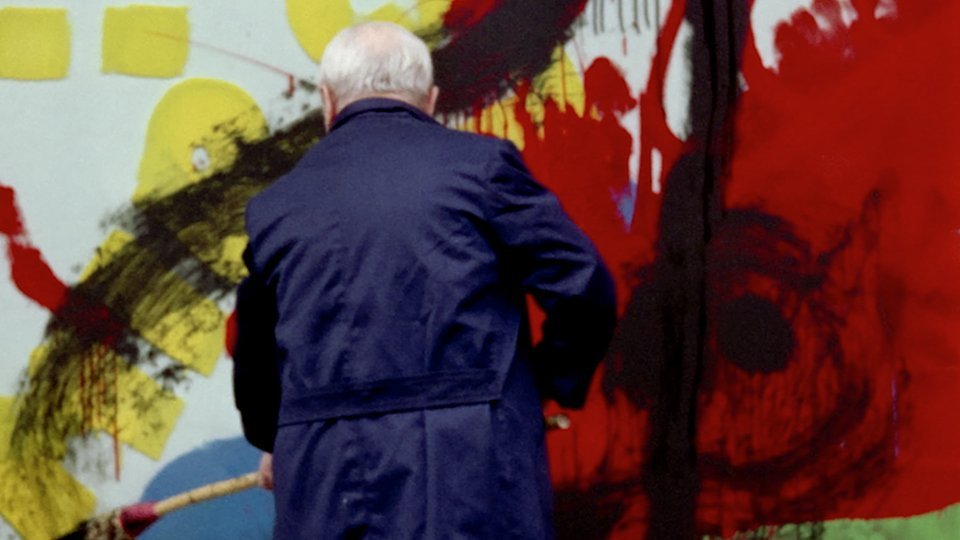
The exhibition takes as its starting point the criticism levelled in 1926 by Louis Aragon and André Breton during Serge de Diaghilev’s ballet Romeo and Juliet, for which Miró designed the costumes. It is from the leaflet brandished by the two Surrealists on that occasion that the exhibition takes its title: *Protest*. Through a collection of works rarely shown in France, the exhibition traces various moments of experimentation that bear witness to the place of protest in Miró’s artistic exploration, as he engaged in a head-to-head struggle with painting, going so far as to ‘murder’ it. Against a backdrop marked by the war and the Franco regime (1936–1975), Miró reappropriated protest and transformed it into a creative act that was itself a form of dissent. The exhibition thus highlights an artist who was resolutely in tune with his era, as well as the political resonance of his work, by presenting his collaborations with a young generation of politically engaged artists (Josep Royo, Pere Portabella and the theatre troupe La Claca).
Organised chronologically, the exhibition traces Miró’s various attempts to move beyond painting and shows how these efforts echoed contemporary events.
Between 1927 and 1937, in particular, he turned his attention to dance, with the ballets Romeo and Juliet and then Children’s Games, but also to unusual materials, painting on unprimed canvas or sandpaper. Without abandoning his characteristic Miró style, the following decades were marked by the use of humble materials, an austerity of composition, the brutality of forms, the deformity of bodies and the sense of gesture. This aesthetic approach, evident in the Series Barcelona (1939–1944) and in the canvases produced in the 1970s, reflects his desire to demystify an academic art form that had all too often become dominant, whilst also highlighting the deeply protest-oriented nature of his work.
The body of work on display also reveals Miró’s impressive ability to constantly question his own work, radicalising his approach to painting, particularly through the relationships he forged with a younger generation of politically engaged artists.
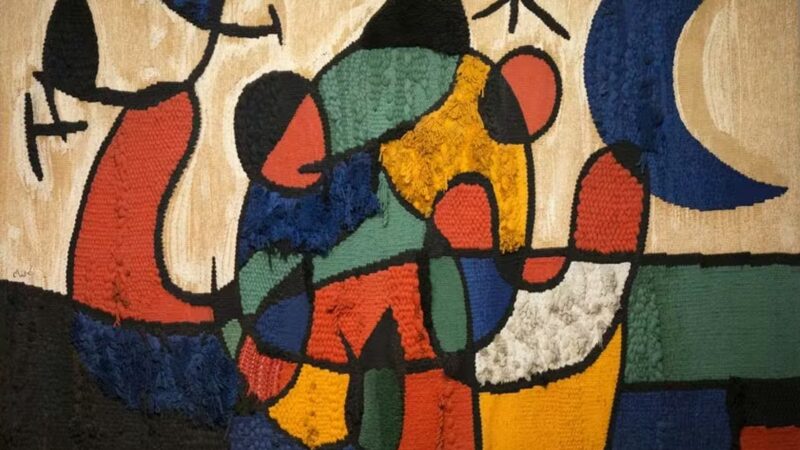
In the mid-1970s, several like-minded figures joined him: the tapestry artist Josep Royo (born 1945), the filmmaker Pere Portabella (born 1927) and the theatre troupe La Claca, who saw in Miró the embodiment of a rebellious tradition. Each, through their own medium – tapestry, film and theatre – contributed to a shared endeavour: the collective demise of painting and the dictator. The exhibition’s narrative highlights this ‘Miró-esque’ constellation, which opens up new avenues for understanding his work. Remarkable bodies of work are presented together for the first time, revealing the significant collaborative dimension of Miró’s work. Among other things, the exhibition brings together an exceptional collection of tapestries and ‘sobreteixims’ produced at La Farinera in Tarragona, in collaboration with Josep Royo. Also on display are the costumes designed by Miró for the play Mori el Merma, conceived in 1976 with the theatre company La Claca. Loosely inspired by Alfred Jarry’s satire Ubu Roi, this project demonstrates Miró’s interest in the figure of Ubu—a caricature of the despot—who recurs throughout his work and who here takes on the features of General Franco. Finally, a series of films directed by Pere Portabella punctuates the exhibition’s narrative, each bearing witness to the power of these artistic experiments and their political significance, in a moment of solidarity with a youth in resistance.
This unique approach thus seeks to undermine both the notion of the solitary genius and that of the ‘late work’, concepts often employed to portray great modern artists. It thus demonstrates how, by subverting the act of protest, Miró continually challenges his own painting, turning it into an object of protest in its own right, embodying the tensions of his era. He thus becomes the icon of anti-authoritarian fervour.
Curators
Carles Guerra, Art Historian and independent curator
Lauriane Gricourt, Director, Les Abattoirs
This exhibition is co-produced by the City of Toulouse and Toulouse Métropole
And the support of l'État - Préfecture de la Région Occitanie
The exhibition receives funding from Banque populaire Occitane.

In media partnership with ICI Occitanie, Le Figaro, Beaux Arts Magazine, Arte and France Culture
This exhibition participates in "Acció Portabella, marking the 100th anniversary of Pere Portabella”